Adored by secularists, feared by the pious, Sam Harris' best-selling books argue that religion is ruinous and, worse, stupid -- and that questioning religious faith might just save civilization.
Science writer Clay Farris Naff wrote a marvelous essay in the Huffington Post, in which he makes a case for his belief that "at this historical moment it is in religion that hatred finds its most powerful and all-consuming expression."
Naff cites these examples of faith-based hatred:
The notorious Westboro Baptist Church, whose members picket funerals of U.S. soldiers because "God hates fags." And God also apparently hates Jews.
Rabbis Yitzhak Shapira and Yosef Elitzur have published a new exegesis of the Torah in which the prohibition "Thou Shalt Not Murder" applies only "to a Jew who kills a Jew."
One Muhammad Hussein Yaaqub went on Egyptian TV to assure viewers that "The Jews are our enemies. Allah will annihilate them at our hands."
Apparently, God also hates President Obama, according to preacher Steven Anderson of the Faithful Word Baptist Church.
If you suspect, as I do, that religion evolved as a human trait that conferred advantage on groups by increasing solidarity in the competition against other groups, then it's all too easy to see how hatred would become an enduring feature of religion.
The vast majority of conflicts have at its root some kind of religious reason. People have been cherry-picking their respective holy books for reasons to hate, and reasons why our in-group supposedly is superior to all other out-groups.
Think of how peaceful the world would be if, in a triumphant moment of rationalism, we got rid of organized religion. Instead of all kinds of "us-versus-them" reasons to hate, we just follow the universal ethical rule to be kind to all people. Will that day come?
Westboro Baptist Church of Topeka, Kansas, as some of you may know, is the name of the Westboro Baptist Church, the ragtag group of idiots and loons who "protest" at U.S. soldiers funerals. They claim that U.S. soldiers die in Iraq and Afghanistan because the U.S. military tolerates gays and lesbians. So, God is punishing them by killing them.
Michael Smerconish, columnist of the Philadelphia Daily News, sums up one such case: Marine Lance Cpl. Matthew Snyder died in combat in Iraq on March 3, 2006. At his funeral, his family had to endure the demented rantings of the Westboro Baptist Church, their placards that said "God Hates the USA," "Fag Troops" and "You're Going to Hell."
Al Snyder, the father of Marine Lance Cpl. Matthew Snyder, sued Phelps and Westboro Baptist. He won a $10.9 million award from a jury that was later reduced by the court to $5 million. Westboro Baptist, of Topeka, Kansas, appealed. The U.S. Court of Appeals for the Fourth Circuit reversed the trial court's verdict. Earlier this month, the Supreme Court agreed to hear the case.
I am not a lawyer, and I don't know if an exemption to the First Amendment can be made for offensive speech at military funerals. That's a question for the U.S. Supreme Court.
I'm only interested in the tired old saw that religious people are more moral. I came across a video by the BBC about the Phelps family who heads this group. Granted, this is an extreme example. But anyone who believes anything religion tells him, on little or no evidence, is guilty of the same thing. It's only a question of degree. Some people who are religious are upstanding citizens. Some use their religion to justify killing others. People have been cherry-picking their respective holy books to justify anything, good or bad. Why not discard the holy books and just be good to everyone?
By the way, "Reverend" Phelps' estranged son Nate tells his story in an article called "Dad, the hateful preacher." He has a blog. And, "for those of you who suffer or who have suffered the effects of being raised in a fundamentalist environment, please join myself and Brother Richard at our Support group, "Life After Christian Fundamentalism."
Another day. Another slew of reports about mayhem in the name of God.
Two female suicide bombers blew themselves up Monday in twin attacks on the Moscow subway, killing at least 38 and wounding at least 60, according to the Associated Press. The carnage blamed on rebels from the Caucasus region follows the killings of several high-profile Islamic militant leaders there. The rebels receive moral and perhaps financial support from al-Qaeda.
The New York Times reports that 9 members of the Michigan-based Christian militia group were arrested and indicted on sedition and weapons charges linked to an alleged plot. They were reportedly planning to to murder law enforcement officers in hopes of setting off an anti-government uprising.
And, oh, this week is Holy Week. Holy Week for Christians is a perfect time for contrition -- except when you're the Pope. Then you're exempt. Reuters says Pope Benedict (then Cardinal Joseph Ratzinger) is undeterred by the latest pedophile-priest sex abuse scandals. In his sermon on Palm Sunday, he credits faith as helping to lead "toward the courage of not allowing oneself to be intimidated by the petty gossip of dominant opinion."
Petty gossip my ass.
According to the Reuters article:
Until the mid-1990s, the then Cardinal Joseph Ratzinger seemed to share a widespread view in the hierarchy that sexual misconduct by priests -- even pedophilia -- could be cured by proper doses of Christian forgiveness and modern therapy.
Pedophilia is a crime. If they weren't priests, they would have been hauled in jail immediately. They can give these criminal priests all the "Christian forgiveness and modern therapy" they need -- but as long as they're locked away in prison and can no longer ruin the lives of children.
Pope Benedict headed an office (before his election as pope) that repeatedly didn't do the right thing when confronted by examples of flagrant sex abuse. In a letter to Irish Catholics, he blamed the Irish bishops for failing to apply church law to stop abusive priests. The Vatican has blamed the media for focusing on the pope. When you're the pope, you can blame everybody else.
British protesters in London are calling for the pope to resign. I don't know about the arcane rules of the Roman Catholic church, but if he were the CEO of a business, and he knew that sex abuse of children was taking place on his company's premises, he would lose his job in a heartbeat.
I thought Turkey was relatively secular and modern. Evidently I was wrong. Or maybe there are two Turkeys, the secular and modern big-city version, and the deeply religious and impoverished one.
Turkish police have recovered the body of a 16-year-old girl they say was buried alive by relatives, according to The Guardian. The apparent crime was done in an "honor" killing, carried out as punishment for talking to boys.
Her father and grandfather are said to have been arrested and held in custody pending trial. It is unclear whether they have been charged. The girl's mother was arrested but was later released.
Media reports said the father had told relatives he was unhappy that his daughter – one of nine children – had male friends. The grandfather is said to have beaten her for having relations with the opposite sex.
The murderers killed a girl because she was talking to a boy? Unconscionable. But let's not single out Turkey. The United States also has its version of the Taliban. It's called the Religious Right.
The details of the case are blood-curdling. A post-mortem examination showed "large amounts of soil in her lungs and stomach, indicating that she had been alive and conscious while being buried." (Italics mine.)
What is it about the ultra-religious of every cultural background that they can justify the oppression of women?
Check out this Gallup poll that says Asian Americans are less religious than other racial, ethnic groups:
Generally speaking, Americans who are less religious tend to be more Democratic and more liberal than Americans who are more religious, and Asians seem to follow this pattern. Comparatively, Asian-Americans tend to be less religious than those in other racial or ethnic groups. For example, just over half of Asians say religion is an important part of their daily lives, significantly lower than the percentage of whites, blacks, or Hispanics who say this.
The poll is about Americans' political leanings. Asian-Americans tend to be more Democratic and more liberal than average Americans, and supported Barack Obama over John McCain by a roughly 2-to-1 margin.
Philosophy professor Rebecca Goldstein -- a 1996 winner of the MacArthur Award (also known as the "genius" award) who earned her Ph.D. at Princeton-- has written a new novel, 36 Arguments for the Existence of God -- A Work of Fiction.
From the Publishers Weekly editorial review:
Cass Seltzer, a university professor specializing in the psychology of religion, hits the big time with a bestselling book and an offer to teach at Harvard—quite a step up from his current position at Frankfurter University. While waiting for his girlfriend to return from a conference, Cass receives an unexpected visit from Roz Margolis, whom he dated 20 years earlier and who looks as good now as she ever did. Her secret: dedicating her substantial smarts to unlocking the secrets of immortality. Cass's recent success and Roz's sudden appearance send him into contemplation of the tumultuous events of his past, involving his former mentor, his failed first marriage and a young mathematical prodigy whose talent may go unrealized, culminating in a standing-room-only debate with a formidable opponent where Cass must reconcile his new, unfamiliar life with his experience of himself. Irreverent and witty, Goldstein seamlessly weaves philosophy into this lively and colorful chronicle of intellectual and emotional struggles.
Oh, by the way, she's also married to Harvard and MIT cognitive psychologist Steven Pinker.
In case you haven't had a chance to read her new novel, here's a video of Pinker interviewing Goldstein:
I like Rebecca Goldstein. She told Christopher Lydon, host of Open Source from Brown University, that she's
"not very uncomfortable with some of the belittling descriptions of religious people ... Religion and religious emotion are so much more complicated than that. One of the things that Spinoza taught us, and it's being validated finally in neuroscientific labs, is that emotions and intellect, cognitions and passion, are inextricably bound up with one another. Cognitive states are also emotional states, and emotional states make cognitive claims.."
I know intelligent people, as well as stupid people, who are religious. Goldstein quotes John Locke to Lydon on religious enthusiasm, saying: look, it's not a source of truth. It is powerful and it is ecstatic." I happen to think that most religious apologists' arguments are hogwash, but we can disagree with each other without being disagreeable. I think that if anyone can pull off a book about disagreement that does not preclude reconciliation, Goldstein can.
Speakers: Deepak Chopra, Jean Houston, Michael Shermer and Sam Harris
From The Skeptic website:
New York Times bestselling author Deepak Chopra is an MD and board-certified Internist and endocrinologist. He is a Fellow of the American College of Physicians and guest lecturer annually at the Update in Internal Medicine CME Course Beth Israel Hospital Boston Harvard Medical School. He directs the educational programs at the Chopra Center for Well Being. Hailed by Time magazine as one of the 100 icons of the century, and credited as "the poet-prophet of alternative medicine," Chopra is the author of more than 55 books that have been translated into 35 languages and sold over 20 million copies worldwide.
Dr. Jean Houston (B.A. from Barnard College, Ph.D. in psychology from the Union Graduate School and a Ph.D in religion from the Graduate Theological Foundation) is a scholar, philosopher and researcher in human capacities, and is one of the principal founders of the Human Potential Movement. A powerful and dynamic speaker, she holds conferences and seminars with social leaders, educational institutions and business organizations worldwide. She is the author of 26 books including A Passion for the Possible, Search for the Beloved, Life Force, The Possible Human, Public Like a Frog, A Mythic Life: Learning to Live Our Greater Story, and Manual of the Peacemaker.
Dr. Michael Shermer is the Founding Publisher of Skeptic magazine, a monthly columnist for Scientific American, an adjunct professor at Claremont Graduate University, and the author of The Mind of the Market, Why Darwin Matters, The Science of Good and Evil and Why People Believe Weird Things. Dr. Shermer received his B.A. in psychology from Pepperdine University, M.A. in experimental psychology from California State University, Fullerton, and his Ph.D. in the history of science from Claremont Graduate University. He has appeared on such shows as The Colbert Report, 20/20, Dateline, Charlie Rose, and Larry King Live.
Dr. Sam Harris is a neuroscientist and the author of the New York Times bestsellers The End of Faith and Letter to a Christian Nation. The End of Faith won the 2005 PEN Award for Nonfiction. Harris's writing has been published in over 15 languages. He is a Co-Founder and CEO of The Reason Project, a nonprofit foundation devoted to spreading scientific knowledge and secular values in society. He received a degree in philosophy from Stanford University and a Ph.D. in neuroscience from UCLA.
Bart Ehrman is an American New Testament scholar and textual critic of early Christianity. He is the James A. Gray Distinguished Professor and chair of the Department of Religious Studies at the University of North Carolina at Chapel Hill.
According to wikipedia,
Ehrman became an Evangelical Christian as a teen. His desire to understand the original words of the Bible led him to the study of ancient languages and to textual criticism, to which he attributes the inspiration for an ongoing critical exploration of the basis of his own religious beliefs, which in turn gradually led to the questioning of his faith in the Bible as the inerrant, unchanging word of God. He now considers himself an agnostic.
Even though I think the title "reverend" is an empty and bogus title, I wouldn't even apply it to you for fear of besmirching it.
That's how low you've sunk in the eyes of all decent human beings. You are a shameful excuse for a human being. You're senile, stupid and a racist to boot. What comes out of your mouth could charitably be described as oral diarrhea.
The death toll from the Jan. 12 Haiti earthquake has exceeded 200,000. In the midst of so much suffering, Pat Robertson had this to say on his show, The 700 Club:
Robertson: "Something happened a long time ago in Haiti, and people might not want to talk about it. They were under the heel of the French. You know, Napoleon III, or whatever. And they got together and swore a pact to the Devil. They said, we will serve you if you'll get us free from the French. True story. And so, the Devil said, okay it's a deal."
What he was referring to, allegedly, was the 1791 slave uprising against the French at Bois Caiman, where the slaves allegedly made a famous pact with the devil in exchange for victory over the French.
Haiti's slave revolt in the 18th century was the first and only successful revolt in the Americas to overthrow oppression. And, as the Haitian ambassador to the United States, Raymond Joseph, pointed out on the Rachel Maddow show, Robertson shows a woeful ignorance of history.
The only responsible response to the disaster in Haiti is to help in any way you can. Donate money, as I and a lot of Americans have done. Go to Haiti to help with rescue efforts, as a lot of Americans have also done. Go to Charity Navigator to give to agencies and NGOs that work to alleviate Haiti's suffering.
Pat Robertson is supposedly something of an "expert" on Hell. Good, because he's going to be in it when he dies.
He was the patriarch of the “prosperity gospel,” a theology that promotes the idea that Christians who pray and donate with sufficient fervency will be rewarded with health, wealth and happiness. Mr. Roberts trained and mentored several generations of younger prosperity gospel preachers who now have television and multimedia empires of their own.
The hucksters who implore you on TV to max out your credit card so that God can reward your devotion with wealth, those are the ones whom he trained.
As for his purported ability to heal, according to the obituary in New York Times: "Leaders of the Roman Catholic Church in the United States and other religious denominations questioned the authenticity of the healing. In the mid-1950s, in a step that would become familiar, a group of Arizona ministers offered to pay $1,000 to anyone who had been healed by Mr. Roberts and could provide medical proof. They received no response."
Some of the comments to the NYT obituary:
He invested early in the American religion bubble and cashed out a rich man.
I remember him as one of the white evangelical leaders who fought tooth-and-nails against MLK and Civil Rights movement in the 1960s (along with Jerry Falwell).
One of the great American confidence artists. The mullahs of Iran have nothing on him.How many people did he brainwash out of their hard earned money?
One of the greatest flim-flam artists of all time!
Seems like Roberts was in the habit of talking to God or receiving visions from God. He founded Oral Roberts University in 1963, obeying a command from God. (Apparently God had no objection to his self-aggrandizingly naming it after himself. Why didn't God demand that it be named after, say, Jesus?) In 1977, according to Wikipedia, he had a vision from a 900-ft. Jesus to build City of Faith Medical and Research Center and the hospital would be a success. It operated for only eight years before folding.
Also from the wikipedia entry:
Harry McNevin said that in 1988 the ORU Board of Regents "rubber-stamped" the "use of millions in endowment money to buy a Beverly Hills property so that Oral Roberts could have a West Coast office and house." In addition he said a country club membership was purchased for the Robertses' home. The lavish expenses led to McNevin's resignation from the Board.
There's a sucker born every minute, and in the USA there are more charlatans to take advantage of them than in any other country in the planet.
On Thursday night, MSNBC host Rachel Maddow reviewed Rick Warren's video condemnation of an anti-gay law in Uganda. While she said the statement was "better late than never," she stated that the famous pastor came up a little short.
In his message, Warren claimed to be incredulous that his public opinion on the issue should matter. Maddow showed a clip of Warren saying he never campaigned on the issue of Proposition 8 -- followed immediately by a clip of the pastor telling supporters to vote yes on the gay marriage ban.
(By the way, I violently disagreed with Obama choosing Warren to speak at his inauguration. If he had to choose a Christian religious figure, why didn't he go with evangelical Christian and social-justice advocate Jim Wallis instead?)
Rick Warren has sold tens of millions of books selling his "softer" version of Christianity. That means he leavens extreme views about social issues (stem cell research, evolution, same sex marriage, abortion, etc.) with a show of concern about environmentalism and fighting poverty.
spoke out in favor of creationism. He also said that brutal dictators such as Mao, Stalin and Pol Pot were all atheists, when questioned on whether religion is beneficial to society.In 2005, during theTerri Schiavocontroversy, Warren stated that withholding feeding to Schiavo, a woman in a persistent vegetative state, was "not a right to die issue". He then called Michael Schiavo's decision to remove her feeding tube, "an atrocity worthy of Nazism", and while speculating about Michael's Schiavo's motives, put forward the idea that Schiavo wanted Terri to die because, if she regained consciousness, she might have "something to say that he didn‘t want said."
But I thought Tea Partiers believed in limited government. Now they want the government to impose the singing of Christmas carols on U.S. schoolchildren? Never mind that many of them, children of U.S. taxpayers, belong to other religions like Judaism, Wicca, Buddhism, Hinduism, etc.
Apparently, Merry Hyatt, of the Tea Party movement, wants to crap on the U.S. Constitution. More likely she hasn't read it. (Do these people read anything? I'm afraid to ask.)
The text of the first amendment is as follows:
Congress shall make no law respecting an establishment of religion, or prohibiting the free exercise thereof; or abridging the freedom of speech, or of the press; or the right of the people peaceably to assemble, and to petition the Government for a redress of grievances.
From the New York Times comes this disturbing article by Simon Romero about robbers looting graves for human bones. Why are they doing such a gruesome thing?
Accompanying Venezuela’s soaring levels of murders and kidnappings, its cemeteries are the setting for a new kind of crime wave. Grave robbers are looting them for human bones, answering demand from some practitioners of a fast-growing transplanted Cuban religion called Palo that uses the bones in its ceremonies.
Palo, according to wikipedia, on two main pillars: 1. The veneration of the spirits of the ancestors. 2. The belief in natural ("earth") powers.
Apparently, Cubans have been going to Venezuela shortly after Hugo Chavez took office in 1999, according to the Christian Science Monitor. (Or the first wave of Cubans were fleeing the revolution in the early 1960s, according to the New York Times article.) They "provide invaluable aid in areas where Cuba's socialist revolution has made internationally recognized strides, such as health and education." But the influx of Cubans also have led to unintended consequences.
Practitioners here of Palo contend their religion is misunderstood and demonized because of the reports of chaos at the Cementerio del Sur.
They acknowledged the importance in their religion of human bones, which they place in a cauldron called a nganga, along with earth and sticks, and dedicate to a spirit, or mpungu. But paleros, as the religion’s adherents are known, shield many of their practices from outsiders.
“We must take care since it is easy to blame paleros for all the ills of Venezuela,” said Samuel Zambrano, 34, a palero leader.
Every day, it seems, brings further proof of the mayhem that religion brings.
Believers know, just know, that their religion is the best one, and all who don't believe in their religion are doomed. Their holy book, whichever it may be, is the only right one.
There is not one shred of evidence to back up their beliefs, but "you have to have faith." On the other hand, when it comes to something that is backed up by tons of evidence (like evolution), they cast the evidence aside because it's not in their holy book. And for those who believe in creationism (or "intelligent design"), check out this presentation by Neil deGrasse Tyson, director of the Hayden Planetarium, at the 2006 Beyond Belief conference.
It does not bother them that their holy book is full of examples that the people who wrote their holy book apparently knew less about science than the average fourth-grader today.
I could go on and on, but you get the picture.
I don't care if people believed weird things so long as they don't force us to believe them as well or obey their religion's teachings. But when they seek to impose their religious beliefs on the rest of us, I feel I have to object. And you should, too.
I think the real lead is somewhat buried, so don't stop reading until you get to the end. Montana now has three rabbis -- two in Bozeman and one (LOL) in Whitefish:
They were all at the Capitol on the first night of last year to light a menorah in the ornate Capitol rotunda
The menorah was lighted and Hebrew prayers chanted, while the officer watched from a distance with his dog. He figured he would let it all go down and then move in when the ceremony was done. The dog sat at attention, watching the ceremony with a peculiar expression on its face, a look of intense interest. When the ceremony was over, the officer approached the Hasidic rabbi.
“I’m Officer John Fosket of the Helena Police,” he said. “This is Miky, our security dog. Do you mind if I ask you a few questions?”
Miky, pronounced Mikey, is in a Diaspora of his own. He was born in an animal shelter in Holland and shipped as a puppy to Israel, where he was trained by the Israeli Defense Forces to sniff out explosives. Then one day, Miky got a plane ticket to America. Rather than spend the standard $20,000 on a bomb dog, the Helena Police Department had shopped around and discovered that it could import a surplus bomb dog from the Israeli forces for the price of the flight. So Miky came to his new home in Helena, to join the police force.
The problem, the officer explained, was that Miky had been trained entirely in Hebrew.
The upshot was the Hasidic rabbi wound up "helping the Montana cop speak Hebrew to his dog. It is good news all around. The officer keeps the Capitol safe, and the Hebrew pooch is feeling more at home hearing his native tongue."
It's a good read. A real feel-good story. I heartily recommend it.
Meditation teacher Jonathan Foust mentioned this episode of "30 Days" in his class recently. You have to give the guy (Dave Stacy) credit for his willingness to be ultimately open-minded. It was a very intense 30 days. He began his journey at West Virginia airport, where he was stopped by security because he was wearing Muslim garb. He had never been discriminated against or profiled before. At the beginning, he felt like a fish out of water. He really had trouble praying the Muslim way. But after 30 days he saw the Muslim-American community of Dearborn as compassionate and good people, and he realized the folly of stereotyping a whole community because of the evil actions of some.
A Christian agrees to uproot his life among his like-minded family and friends and live for 30 Days in a large Muslim community in Dearborn, Michigan. hulu.com
Actually, no God, BIG problem, because that would mean this life is all there is and, thus, without purpose or meaning and without hope for anything beyond this life. And if there is no God the very idea of "goodness" becomes relative and subject to change. Even dictators think they are doing "good."
The bigger question is: If one can be "good" without God, why bother? Indulge yourself. Be selfish. Be promiscuous. Cheat on your spouse. Cheat on your taxes. Lie and steal. Hate and destroy your enemies. If there is no God, who is to say anything is bad . . . or good?
Let's examine Thomas's argument, which is not even original in its speciousness. It's a rehash of tired old tripes that every agnostic regularly hears.
All of Africa is religious, as is also the Middle East (except Israel, where 75% are not religious. Isn't that interesting?). All of Latin America is religious, except for Argentina (39% say religion is unimportant in their lives).
Rates of atheism and secularity are markedly high in Europe, according to Zuckerman. Sweden (up to 85% non-believer) and Denmark consistently rank near the top of the most atheist countries in the world. In North America, 28% of Canadians are secular. Among Americans, the more educated they are, the more likely that they are to be atheist, agnostic or secular.
Would you rather be stuck alone as a stranger in Sweden or in Saudi Arabia? Data have consistently shown that in terms of societal health (which measures education, health care, crime rates, etc.), the more "atheistic" countries are better than more religious ones.
2. If there is no belief in an afterlife or divine punishment, why bother to be good? When was the last time you said to yourself, "I'd better not do this evil thing because I don't want to go to Hell." Be honest. I've never used that reasoning myself, and I was raised Catholic. I don't need a celestial dictator to frighten me into being good. The average Swede or Dane, I'm sure, don't even think of Hell in their daily life, and they have no trouble being for the most part ethical and good people.
Babies are innately sociable and helpful to others. Of course every animal must to some extent be selfish to survive. But the biologists also see in humans a natural willingness to help.
... When infants 18 months old see an unrelated adult whose hands are full and who needs assistance opening a door or picking up a dropped clothespin, they will immediately help ... The helping behavior seems to be innate because it appears so early and before many parents start teaching children the rules of polite behavior. (Underscoring mine.)
"When I do good, I feel good. When I do bad, I feel bad. That's my religion," President Lincoln said. I agree.
4. If we believe "God" had told us something, it's easier to be evil. Let me tell you a story. Once there were a group of men who, based on what God supposedly told them, flew two planes into the World Trade Center in New York City. Need I say more?
U.S. physicist and Nobel laureate Steven Weinberg sums it up this way: "I think on balance the moral influence of religion has been awful. With or without religion, good people can behave well and bad people can do evil. But for good people to do evil -- that takes religion."
Apparently, the problem is not evolution, it's human evolution.
For many Muslims, even evolution and the notion that life flourished without the intervening hand of Allah is largely compatible with their religion. What many find unacceptable is human evolution, the idea that humans evolved from primitive primates. The Koran states that Allah created Adam, the first man, separately out of clay.
Pervez A. Hoodbhoy, a prominent atomic physicist at Quaid-e-Azam University in Pakistan, said that when he gave lectures covering the sweep of cosmological history from the Big Bang to the evolution of life on Earth, the audience listened without objection to most of it. “Everything is O.K. until the apes stand up,” Dr. Hoodbhoy said.
What jumped out at me is the notion that "a negative reaction to evolutionary theory could reflect a struggle to retain cultural traditions and values against Western influences," according to Salman Hameed, who convened the two-day conference here at Hampshire College.
That makes sense to me.
The article by Kenneth Chang goes on to say that "in the West, where non-Islamic influences are strongest, Islamic creationism may be stronger in reaction to the outside pressure." For example, "high school students at Islamic schools in and near Toronto were far more doubting of evolution than students in Indonesia or Pakistan."
In other words, the more a minority feels under threat by the majority culture of the Western society, the more it clings to its own culture. The more the minority feels beleaguered, the more it clings to its beliefs. And the more the minority clings to its beliefs (especially beliefs that are wrong), the more potential for conflict with the majority culture.
Ergo, the more tolerant the majority culture is toward minorities, the less minorities feel the need to cling to their own beliefs, etc., etc. And the less the majority culture has to fear from its minorities.
Chew on that, Lou Dobbs.
(Photo by David Jonathan Ross. Photo credit: Darwin's finches on the Islamic symbol in art work used at a conference in Massachusetts about the acceptance of evolution among Muslims.)
Last month, atheists marked Blasphemy Day at gatherings around the world, and celebrated the freedom to denigrate and insult religion.
Some offered to trade pornography for Bibles. Others de-baptized people with hair dryers. And in Washington, D.C., an art exhibit opened that shows, among other paintings, one entitled Divine Wine, where Jesus, on the cross, has blood flowing from his wound into a wine bottle.
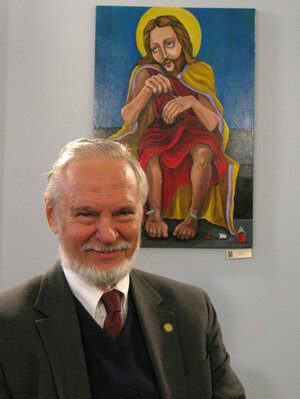
Another, Jesus Paints His Nails, shows an effeminate Jesus after the crucifixion, applying polish to the nails that attach his hands to the cross.
It's no wonder that believers were offended. I was offended, and I'm not a believer.
You don't have to defend reason and science by insulting all religious observance. I don't know about your country, but a lot of believers in the United States belong to the "cafeteria" variety. They have mainstream values, they pick and choose what religious tenets they agree with, and they quietly don't obey the rest. (Ever heard of Catholic couples who use birth control? Or Jewish people who eat bacon?) They adhere to various forms of what is known as the Golden Rule ("Don't injure or harm others. Period.") and don't believe that people who don't agree with them should die.
Most people just follow the religion of their parents and their culture. Life is busy and full of obligations, we are all under a lot of stress, and we shouldn't get down on others because it never occurred to them to question their (and their parents') religious and cultural beliefs. They are not stupid. Not everyone has the leisure, education, interest, etc., to question their or their parents' religious beliefs. They're too busy putting food on the table for their families. As long as they obey the Golden Rule and don't impose their views on others, leave them alone.
Just ignore the more benign forms of religion and only reserve your firepower for the more virulent forms. We nonbelievers don't need to create enemies. We can argue that reason and science is on our side, but we don't have to offend potential allies (and believe me, some religious people are potential allies). If you insult people, you will end up in the lonely position of preaching to the choir, because nobody else will listen to you.
To the atheists who say there are no benign forms of religious observance, I beg to disagree. You can believe all you want that a Pink Unicorn created the universe, and it's none of my business as long as your beliefs stay inside your head. Your freedom to act on your beliefs ends at the point where my nose begins. If you try to restrict my freedoms in any way (or influence politics in such a way that will restrict my freedoms), that's another thing altogether.
So, agnostics and atheists, if you do your best to tamp down the anger between believers and non-believers, you can have a civil (and even cordial) conversation. And that's what I call a good start.
Atheist author Christopher Hitchens, author of the book, "God Is Not Great," went on a debating tour last fall with evangelical Christian Pastor Douglas Wilson. They filmed their debates. The result is a documentary called Collision, directed by filmmaker Darren Doane.
“I loved the idea of putting one of the beltway’s most respected public intellectuals together with an ultra-conservative pastor from Idaho that looks like a lumberjack.”
According to the Collision website, Hitchens and Wilson “ended up at the bar laughing, joking, drinking. There were so many things that they had in common”, said Doane. “They agreed on so many things. Except on the existence of God.”