Showing posts with label religion. Show all posts

January 23, 2010

36 Arguments for the Existence of God

Philosophy professor Rebecca Goldstein -- a 1996 winner of the MacArthur Award (also known as the "genius" award) who earned her Ph.D. at Princeton-- has written a new novel, 36 Arguments for the Existence of God -- A Work of Fiction.

From the Publishers Weekly editorial review:
Cass Seltzer, a university professor specializing in the psychology of religion, hits the big time with a bestselling book and an offer to teach at Harvard—quite a step up from his current position at Frankfurter University. While waiting for his girlfriend to return from a conference, Cass receives an unexpected visit from Roz Margolis, whom he dated 20 years earlier and who looks as good now as she ever did. Her secret: dedicating her substantial smarts to unlocking the secrets of immortality. Cass's recent success and Roz's sudden appearance send him into contemplation of the tumultuous events of his past, involving his former mentor, his failed first marriage and a young mathematical prodigy whose talent may go unrealized, culminating in a standing-room-only debate with a formidable opponent where Cass must reconcile his new, unfamiliar life with his experience of himself. Irreverent and witty, Goldstein seamlessly weaves philosophy into this lively and colorful chronicle of intellectual and emotional struggles.
Oh, by the way, she's also married to Harvard and MIT cognitive psychologist Steven Pinker.

In case you haven't had a chance to read her new novel, here's a video of Pinker interviewing Goldstein:


I like Rebecca Goldstein. She told Christopher Lydon, host of Open Source from Brown University, that she's
"not very uncomfortable with some of the belittling descriptions of religious people ...
Religion and religious emotion are so much more complicated than that. One of the things that Spinoza taught us, and it's being validated finally in neuroscientific labs, is that emotions and intellect, cognitions and passion, are inextricably bound up with one another. Cognitive states are also emotional states, and emotional states make cognitive claims.."
I know intelligent people, as well as stupid people, who are religious. Goldstein quotes John Locke to Lydon on religious enthusiasm, saying: look, it's not a source of truth. It is powerful and it is ecstatic." I happen to think that most religious apologists' arguments are hogwash, but we can disagree with each other without being disagreeable. I think that if anyone can pull off a book about disagreement that does not preclude reconciliation, Goldstein can.



December 11, 2009

Christmas Carols and blind faith

But I thought Tea Partiers believed in limited government. Now they want the government to impose the singing of Christmas carols on U.S. schoolchildren? Never mind that many of them, children of U.S. taxpayers, belong to other religions like Judaism, Wicca, Buddhism, Hinduism, etc.

Apparently, Merry Hyatt, of the Tea Party movement, wants to crap on the U.S. Constitution. More likely she hasn't read it. (Do these people read anything? I'm afraid to ask.)

The text of the first amendment is as follows:
Congress shall make no law respecting an establishment of religion, or prohibiting the free exercise thereof; or abridging the freedom of speech, or of the press; or the right of the people peaceably to assemble, and to petition the Government for a redress of grievances.
Read Rachel Weiner's blog entry on it in the Huffington Post.

August 21, 2009

Meditation without borders

Go back to Todayinreligion.com


I just finished reading "How God Changes Your Brain." (One of the authors is Dr. Andrew Newberg, associate professor of radiology and psychiatry at the University of Pennsylvania). I was about to blog about it when I found this Reuters article. Not wanting to wear out my own brain, I am going to quote the Reuters article and then add something of my own.

According to the book, meditation and similar practices (repetitive prayer, or contemplating a benevolent God for example) can change your brain in a positive way. Conversely, you can stimulate the part of your brain involved in such emotions as anger and fear by focusing on a vindictive God. Newberg verified the changes with MRI scans.

From the Reuters article:

"In essence, when you think about the really big questions in life — be they religious, scientific or psychological — your brain is going to grow," says Newberg, head of the Center for Spirituality and the Mind at the University of Pennsylvania.

"It doesn't matter if you're a Christian or a Jew, a Muslim or a Hindu, or an agnostic or an atheist."

So even if you don't believe in God, it's possible to experience what some religious people are experiencing by following their practices. Sam Harris, an atheist, and Robert Wright, an agnostic, have similar views about meditations as Newberg, who meditates but has never practiced a specific religion (link).

Sam Harris, who is a well-known atheist who's also working on a Ph.D. in neuroscience, touched on this in an article entitled Killing the Buddha. He advocates dropping the religious aspects of Buddhism and saving the good parts.

If the methodology of Buddhism (ethical precepts and meditation) uncovers genuine truths about the mind and the phenomenal world — truths like emptiness, selflessness, and impermanence —these truths are not in the least “Buddhist.” No doubt, most serious practitioners of meditation realize this, but most Buddhists do not.

Robert Wright, the author of "The Evolution of God" and an agnostic wrote a New York Times article entitle Self, Meditating. He describes his experiences at his first week-long silent meditation retreat.

The experience changed the way he looked at the world.

"When I first got there, I didn’t understand why some people were closing their eyes while eating. By the end of the retreat, I was closing mine. The better to focus on the source of my ecstasy. I wasn’t just living in the moment — I was luxuriating in it."

So we have an atheist, an agnostic and someone who has never practiced a specific religion — all enthusiastic about meditation. They each approached the subject from different points of view, but they come to the same conclusion


Go back to Todayinreligion.com

August 15, 2009

Prosperity Gospel Preacher Still Raking It In

Go back to Todayinreligion.com

New York Times (August 15, 2009)

Kenneth and Gloria Copeland (and others) are still preaching the "prosperity gospel" and still taking money from people who can least afford it.

From the New York Times article.
Even in an economic downturn, preachers in the “prosperity gospel” movement are drawing sizable, adoring audiences. Their message — that if you have sufficient faith in God and the Bible and donate generously, God will multiply your offerings a hundredfold — is reassuring to many in hard times.
The Copelands' ministry pulls in about $100 million a year. The Times gave one example of a family that is $102,000 in debt and gave the church $2,000 for a new jet and $1,800 to upgrade the ministry's TV equipment.

Much of the money goes to bankroll the Copelands' lavish lifestyle (enormous houses, jets, Rolls Royces, etc.). All of which violate IRS guidelines which require that pastors' compensation be "reasonable".

Sen. Chuck Grassley, R-Iowa, opened an investigating into the Copelands and other prosperity gospel ministers in November 2007 (wikipedia). It's still not finished!

Note to Senator Grassley:
Instead of running around the country ranting and raving about how the proposed health care bill will allow the government to pull the plug on grandma, why don't you wrap up the prosperity ministry investigation. (Youtube)

Here is a CBS News report on Copeland.


Here's a link to a blog I did about Reverend Ike. He was one of the first prosperity gospel ministers, and in my view still the best. The link has a video of Ike in action. You can compare Ike's preaching to Copeland's (below).


Go back to Todayinreligion.com

August 8, 2009

Demographic time bomb in Israel

Go back to Todayinreligion.com

An August 6, 2009, Los Angeles Times article about tensions between ultra-Orthodox and secular Israelis got me thinking about demographics in Israel. It's a problem now. It is going to be a really, really big problem in the not-too-distant future.

In a nutshell, the LA Times article described problems that arose when ultra-Orthodox Jews moved into an upper-class secular Jewish neighborhood of Tel Aviv. Fights over opening a parking lot on the Sabbath, missionary-like practices directed at secular Jews and other activities led to trouble between the two groups.


This July 16, 2009, MSNBC clip about a riot in Jerusalem will give you an idea of what secular Jews are facing.


If demographic trends continue (and they will), these conflicts are only going to grow. From the LA Times article:
With birth rates nearly two or three times the national average, Israel's ultra-Orthodox community is expected to grow from 16% of the population to 23% by 2025. That's only 16 years away.
And then there are the Muslims. According to forecasts, the Israeli Muslim Arab population will grow to more than 2,000,000 people, or 24-26% of the population in less than 15 years. (link).

So, in 15 years (or less), half the population of Israel will be made up of ultra-Orthodox Jews and Muslims. Secular Jews (still the largest group) and non-Muslim Arabs (primarily Christians and Druze) will make up the rest. The percentage of ultra-Orthodox Jews and Muslims will keep increasing at a faster and faster pace.

And then there are the Palestinian Territories.

The Palestinian Territories, with more than 4 million people, is ranked 14th in population density (it would have placed much higher than 14th, but the list is topped with "countries" like Macau, Monaco, Hong Kong, Gibraltar, Vatican City, etc. (link) The Gaza Strip has a yearly population growth rate of about 3.35% and the West Bank is about 2.18%.

Israel also is one of the most crowded countries in the world. It ranked 42nd in population density but as with the Palestinian Territories it really should have been much higher.

More ultra-Orthodox Jews and more marginalized Muslim Arabs in a very small and crowded space. It's going to get ugly.

The video
below (in two parts) by George Negus of Dateline is a good piece on the ultra-Orthodox community.


Go back to Todayinreligion.com

July 30, 2009

The Family

Go back to Todayinreligion.com

Wikipedia entry
Secrets of C-Street
(The Daily Beast)
Harper's Magazine

I really don't know what to make of this. It's too weird.

The Family is a secretive conservative Christian group. Its membership includes U.S. senators, members of Congress, primarily Republican, as well as high-ranking military leaders.

It is best known for organizing the National Prayer Breakfast, held each year on the first Thursday of February in Washington, D.C.

It's also rather well known for recent sex scandals involving three of its members, Gov. Mark Sanford, Sen. John Ensign and former congressman Chip Pickering.


It's less well known for some of its odd beliefs and attempts to influence foreign governments.

According to the Rachel Maddow video shown below, the group believes:
Powerful men are God's chosen and they are not bound by the same morality and responsibility to others that normal people are ... Hitler and Mao and Osama bin Laden should be studied and considered as models of power and leadership by members of the family.
They want to build a worldwide invisible movement of strong authoritarian leaders linked together in a worldwide spiritual offensive.


Powerful members of the House and Senate are going along with this stuff. It's all very creepy.

The video and the article in the Daily Beast will give you a good idea about what they are about. The Harper's article is older and longer but is also very good. The book, pictured above, is on the July 24, 2009, New York Times paperback nonfiction best-seller list.


The Family's house on C street in DC


July 27, 2009

Losing My Religion

Go back to Todayinreligion.com

This may sound odd coming from someone who blogs about religion: I don't like books about religion.

The scholarly books tend to be dry. The books that try to prove God exists don't prove anything. And I know all the atheist arguments.

I enjoy reading about the history of religion and newspaper articles about religion. I just want the facts.

Losing My Religion by William Lobdell is different. Lobdell is a former religion reporter for The Los Angeles Times. So the writing won't put you to sleep. In a nutshell, he chronicles his journey from not being religious, to being born again, to losing his faith. It is almost a psychological analysis of someone falling into and out of religion.

As I suspect is common in a lot of cases, Lobdell was at a low point in his life when he started going to church on a friend's suggestion. This lead to a born-again experience at an all-men's weekend religious retreat. His belief in Christianity was later re-enforced by fortuitous events in his life that Lobdell attributed to prayer.

Lobdell's fall from grace came because of his profession. About three years into his beat as a religion reporter, the Catholic priest pedophile scandal broke in Los Angeles. The denial, the lies, the cover-ups and the slandering of the victims by the church hierarchy led to Lobdell's crisis of faith. As New York Times reviewer Mark Oppenheimer put it: "School systems and Little Leagues don’t defend molesters as tenaciously as the Catholic Church did." (In an odd twist, Lobdell was studying to convert to Catholicism while covering the scandal).

Lobdell's falling out with Catholicism led him to look at other religions and eventually to a re-evaluation of his deeply held belief in Christianity.

If you don't have time for the book, read his 2007 LA Times article about losing his religion.

If you really, really don't have time listen to his 2007 NPR interview about the article.

If you buy the book (or better yet get it from the library), at least read chapter nine about Mormonism. In looking at things that could be easily disproved about Mormonism (such as DNA evidence that Native Americans really come from Asia, and not from the Middle East as Mormons believe), he came to realize that Mormonism is no odder than traditional Christianity.

Here is William Lobdell's website.

Click here for the full New York Times review of his book.

Go back to Todayinreligion.com

July 19, 2009

The Neocatechumenal Way


Go back to Todayinreligion.com

Economist July 16, 2009
The Neocatechumenal Way
Jerusalem Post (good article)

The Catholic Church has been bleeding parishioners for years. One of the few bright spots has been Latinos in the Unites States. And now, according to the Economist, even the Latinos are jumping ship. They are defecting to evangelical and charismatic churches.

The Economist list their reasons for the defections. Here is mine.
I've never met a Catholic parish priest who could deliver a decent talk. They are all boring!

I think the church hierarchy realized they had a problem years ago. With the shortage of clergy (even though they are boring you still need them), plus the attraction of more lively churches they saw what was coming.

And then along came the
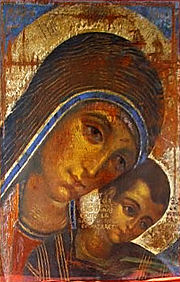
Neocatechumenal Way, also know simply as The Way. The Way is a lay-driven organization made up of small, parish-based communities of between 20-50 people. It was started in Madrid, Spain, in 1964 by Kiko Arguello and Carmen Hernandez. (Arguello is a painter. The painting on this page is his). The pope liked what he saw and supported the Way.

Today, there are around 40,000 communities throughout the world, with an estimated 1 million members.
The Way is essentially a Vatican-sanctioned evangelical movement within the Catholic Church. They are deeply committed to the New Evangelization, which was first mentioned by Pope John Paul II.

The New Evangelization is a movement within the Catholic Church that has lay members as well as clergy. Their mission is to seek converts and bring non-church going Catholics back into the fold. This is new for Catholicism. Lay Catholics have not been evangelical in the past.

I think the Catholic Church may keep their traditional structure (
hierarchical with unmarried male priest at the top) and build up the Neocatechumenal Way (along with other organizations) to counter advances being made by other churches.

There are some who claim The Way is a cult within the Catholic Church and others who claim it is heresy.

My definition of a cult is an organization that is very difficult to leave. And as I understand it, you can walk away from The Way anytime. So I would not classify it as a cult. But that said, I haven't had personal experience with The Way.

As far as the heresy charge goes, if several popes have approved of the Way, I don't see how the heresy charge can stick. The Way does have something called a post-baptism for members who are already Catholic. If I understand it correctly, it's another baptism for adults who have undergone religious instruction. (see reply at bottom)

The Catholics killed thousands of Anabaptists who believed in re-baptizing adults. R
e-baptizing adult Catholics would be a major departure from traditional teaching. If anyone knows more about this practice than I do, please post a comment.

Whether the Neocatechumenal Way helps stanch the departure of Catholics from the church is anybody's guess. It hasn't worked to date, but it seems to be the direction the church is taking.

Go back to Todayinreligion.com


July 17, 2009

Another religious TV show bites the dust

Go back to Todayinreligion.com

Newsweek (July 17, 2009)

Why do TV shows with religious themes keep crashing and burning?

The latest to be canceled is Kings on NBC. Next to go is ABC's Eli Stone. Religious people complain that the godless Hollywood moguls ignore them. But when the moguls produce a religion-friendly show, no one watches it. Joan of Arcadia (2 seasons) and The Book of Daniel (1 season) were two other show with short life spans.

Touched by an Angel (9 seasons) and Highway to Heaven (5 seasons) had good runs. Newsweek claims these two were popular because they are the most treacly (that means sweet or saccharine. I looked it up).

Maybe treacly is what religious people want, but they are also partial to blood and gore. Mel Gibson's The Passion of the Christ was a sadist's dream movie, and it was wildly popular with Christian audiences.

Newsweek thinks:
There's a notion, mostly borne out, that a religious program can serve only one master. Either it attracts people of faith while repelling the secular, or vice versa. In today's ultra-segmented television landscape, a religiously themed show on network TV has to appeal to the faithful and faithless alike in order to trump the ratings of a Desperate Housewives. And it has to have a cool factor. Television has gotten edgier; a show like Highway to Heaven would be a conspicuous fit in any network lineup.
I think the godless TV moguls should forget about competing against Desperate Housewives. They should shoot for the niche market and try to produce something at a reasonable price. If they want edgy, they could use actual stories from the Old Testament. There is enough blood and sex in the Old Testament to make the Marquis de Sade blush.

I suspect fundamentalist/evangelicals want the real thing -- actual Bible stories set 2,000 years ago or earlier. (One possible exception may be a re-do of Left Behind. It might work as a TV series.)

What Hollywood has been dishing up are shows with Christian moral themes set in modern times. Not good enough, guys! There are millions of people in this country who believe the Bible is the literal word of God. Give it to them and see what happens.

Go back to Todayinreligion.com


July 15, 2009

Miss Manners' advice for atheists

Go back to Todayinreligion.com

Washington Post (July 15, 2009)

Advice for atheists from Miss Manners? Why not! But before we get to Miss Manners I'm going to give you my advice. What you don't say can't hurt you.

I've never gotten in trouble when I kept my big mouth shut. And trust me, if you are in the wrong crowd, nothing is as inflammatory as religion. Politics, wars, gay rights and gun control (well maybe not gun control) can all be discussed in a calm voice. Not so with religion.

That said, I think Miss Manners hit the nail right on the head. Unfortunately, she is dealing with a rather civilized situation.

I would love to see her answer to this one. What do you do after you have had a couple of beers and told the wrong person sitting next to you that religion is a lot of nonsense. How do you get out of that one, Miss Manners?

In conclusion, I have adopted a "don't ask don't tell" policy -- unless someone still insists on proselytizing after I have told him or her that I'm not interested.

Anyway, enough from me, here's her column. You can also link to it above.
Dear Miss Manners:

I am an atheist, and this is occasionally the source of mild social awkwardness. Normally, of course, I do not broadcast my beliefs without solicitation, but occasionally I am asked where I go to church or invited to attend a service at another's church.

I work with a number of civic organizations, including places of worship, so this sort of question or request is usually well-intentioned chitchat from someone with whom I am working on a project.

Somehow, the simple and direct, "I choose not to worship a deity," seems as inappropriate for casual conversation as questions about one's religious beliefs. I would greatly appreciate a simple and direct way to decline such an invitation and nip such questioning in the bud. Occasionally, the question comes as a part of direct proselytizing, which I hope requires no more politeness than a sales solicitation.

The second area is how to respond when passing comments are made that imply a belief in a god, as if one were discussing the weather, such as "He's in a better place now," "The Lord works in mysterious ways" or "I know Jesus will take care of this for me."

I know the speaker is expecting a smile and a nod, but if I consider these beliefs untrue, offensive or ridiculous, how can I respond in a simple way that does not sound strident, open me up to being evangelized or invite the beginning of a theological debate?

Another area of consternation is in expressions of sympathy. Can you recommend a standard replacement for "He/she is in my prayers," for people who do not pray?

Answer
Please keep in mind that the idea here would not be to declare your own convictions, a habit you find objectionable in others, but to deflect the topic without seeming to acquiesce.

Miss Manners suggests separating the proselytizers from those who may be merely repeating figures of speech. Not everyone who says "Bless you" when you sneeze or even "The Lord works in mysterious ways" is voicing a theological conviction.

In any case, the comments of the second group should be treated as if they were good wishes. Similarly, the inquiry about where you go to church should be treated as a casual social question.

"I choose not to worship a deity" is indeed pompous, and also challenging. You need only say casually, "I'm not a churchgoer." Only if this leads to argument need you say -- because you must also be polite to proselytizers -- "It's not something I discuss."


Go back to Todayinreligion.com


July 9, 2009

Geneticist Francis Collins to head NIH

Go back to Todayinreligion.com

Washington Post (July 15, 2009) Update!, Update!, Update!
Michael Gerson comments on the appointment Dr Francis Collins to head the NIH. (He thinks it's a good idea.)

New York Times (July 9, 2009)

Dr. Francis Collins has been nominated to head the National Institute of Health. Collins is an accomplished scientist, a proven administrator, articulate and an Evangelical Christian. It's that last one that is going to attract a lot of attention.

His journey from atheism to evangelical Christianity took a pivotal turn in the Cascade Mountains. While hiking, he came across a waterfall that happened to have three frozen streams. The three streams reminded Collins of the trinity, and he surrendered to Jesus (link). It's a little surprising that the man who headed the human genome project would take a leap of faith at the sight of frozen water. But that's what happened. (Bill Maher interviewed Collins for his movie, Religulous.)

In the video, below, Collins explains how his journey to Christianity began. He started to wonder about life and death when he left chemistry and went into medicine.
When I went to medical school the ideas about death and dying which had been rather hypothetical became very real. You can't be in that environment sitting at the bedside of people facing the end of their lives without having it affect you.


A couple of years later, he had his born-again experience in the Cascades. I don't know what's in his head, but it sounds like seeing people die shook him up a bit and maybe got him thinking about the end of his own consciousness. If that's something you're concerned about, you'll eventually end up at religion. There is no other place to go.

One other thing that might draw some questions during his confirmation hearing is that he doesn't believe that homosexuality is hardwired (link).
An area of particularly strong public interest is the genetic basis of homosexuality. Evidence from twin studies does in fact support the conclusion that heritable factors play a role in male homosexuality. However, the likelihood that the identical twin of a homosexual male will also be gay is about 20% (compared with 2-4 percent of males in the general population), indicating that sexual orientation is genetically influenced but not hardwired by DNA, and that whatever genes are involved represent predispositions, not predeterminations.
It looks like Collins will be the next head of the NIH even if some of his views are not in line with his fellow scientists. I think President Obama managed to throw the religious right a bone and will end up with a competent administrator worth watching.

Go back to Todayinreligion.com

Another Pig in a Python

Go back to Todayinreligion.com

It's starting! Another generational pig is making its way through the python.

For the past hundred years, the United States has vacillated between large and small generations. The trend was started with the influx of European immigrants around the beginning of the 20th century and was cemented in place with the Immigration Act of 1924, which restricted immigration.

Another large generation is rolling around. The echo boomers (millennium generation, Gen Y or Gen Next) were born roughly between 1982-1995. Soon they will dominate the social and economic fabric of the United States.

The Pew Research Center has released a survey of their attitudes. They tend to be more liberal, tolerant, more likely to vote Democratic and less religious than previous generations.

From the above link:

One-in-five members of Generation Next say they have no religious affiliation or are atheist or agnostic, nearly double the proportion of young people who said that in the late 1980s. And just 4% of Gen Nexters say people in their generation view becoming more spiritual as their most important goal in life.

This doesn't bode well for organized religion.

The above link has a good synopsis of their other characteristics. I would like to touch on their potential economic impact, which was not covered in the Pew study. True, this has nothing to do with religion but, it is very interesting.

In the past, whenever a large generation reaches their prime working years, there are technological advances and the stock market shoots up.

The below chart shows the progression of the stock market during the past 100 years. As you can see, it doesn't go up in a straight line.

Let's focus on the three most recent large generations, the stock market and innovation.

The GI Generation was the first big one in the 20th century. They were born between 1901-1924 (many were children of immigrants). The stock market shot up between 1946-1965 (19 years) during this time, the youngest person of that generation was 22 and the oldest was 64.* The technological advances included mainframe computers, jets, solid state transistors, etc.

The Boomers were the children of the GI Generation. They were born between 1946 and approximately 1963. The stock market shot up between 1982-2000 (18 years) during this time, the youngest boomer was 19 and the oldest was 54. The major technological advance during that time was Information Technology.

The Echo boomers (Millennium generation) are the children of the boomers. They were born roughly between 1982-1995. If the previous two 18 year bull/bear stock market patterns holds up, the market should remain flat until around 2016 and be strong until 2034. During the bull market, the youngest echo boomer will be 21 and the oldest will be 54. The technological advances of this generation are anybody's guess. Thomas L. Friedman of the New York Times thinks it might be energy technology.

There is a fudge factor here. There isn't clear agreement on when a generation begins and ends. However, the long tern stock market trends are pretty clearer. The stock market has been flat since around 2,000 or possibly 1998 depending on how you look at the chart. Therefore, the market has been flat for 9 to 11 years now. Considering the economic mess the country is in, it's not unreasonable to think it might take another five to eight years before the economy and the market pick up again. The Echo boomers might be the engine that pulls the train.

*The working years of the GI Generation are longer than the boomers and echo boomers because the older members of that generation got a late start because of the depression and WWII.

Photo

Go back to Todayinreligion.com

July 6, 2009

President Obama and the Church Thing

Go back to Todayinreligion.com

Hallelujah! President Obama has finally chosen a church. Or has he?

Last week, Time Magazine reported that President Obama had finally settled on a church -- Evergreen Chapel, the nondenominational military chapel at Camp David, the presidential retreat in Maryland.

The White House press secretary, Robert Gibbs later said not exactly: (The Washington Post)

He (the president) said he and his family will attend chapel services at Camp David when they are at the presidential retreat in Maryland -- which he calls a "wonderful little congregation."
"How we handle church when we're here in D.C. is something that we're still figuring out," he said. "And I think that in the second half of the year, we will have made a decision.

What the press secretary failed to mention is that President Obama rarely sets foot in Camp David. And that Obama has only attended church at Camp David a few times (Politico). Looking at how many Sundays he's been at Camp David, I figure a few is maybe two or three.

The press secretary also said that Obama went the same route as President Bush by choosing Evergreen Chapel (link). Bush might have joined Evergreen but he rarely attended services there or at any other church.

The church going habits of the last half dozen presidents are very interesting.

On the Republican side, Ronald Regan never attended church. Bush senior was an infrequent church goer as was W (link). But both previous Democratic presidents Carter and Clinton regularly attended church. Carter attended First Baptist Church in Washington D.C. while he was President. And Clinton attended a Lutheran Church.

I suspect that Carter was the only real believer in the lot. After he left the presidency he actually taught Sunday school and actively participates in his church.

As far as I can tell, President Obama is following the Republicans as far as church attendance is concerned. He has attended Sunday services as president in DC maybe two times.

He went to the 19th Street Baptist Church in January the week before his inauguration. But not as president.

He went to the National Cathedral on the day he was inaugurated and on his 100th day in office. (Both were on a Wednesday and were sort of required because everyone was looking).

His first trip to a real Sunday church service as president was on Easter Sunday. He took the family to St. John’s Episcopal Church which is near the White House. (I am sorry but Easter doesn't count. He had to go to church on Easter. Again because everyone was watching.) He has attended services at St John's one other time (link).

By my count, President Obama has probably been to Sunday church services four or five times since he assumed office a bit more than six months ago.

Combine that with the juicy fact in Richard Wolffe's new book, Renegade, that President Obama really
didn't know about the rantings of Reverend Jeremiah Wright because he rarely attended services at Wright's or any other church unless he was schmoozing people for their votes (see video below).

The president seems to spend his Sundays either at the gym, working, relaxing with his family or playing golf. Which is fine and dandy. If the Republican presidents can play the religion card and not go to church, a Democratic president should be able to do the same thing.


Go back to Todayinreligion.com


July 2, 2009

Stephen Colbert on Cynthia Davis

Go back to Todayinreligion.com

Huffington Post, July 2, 2009

Cynthia Davis, a Missouri state representative and the owner of a Christian bookstore said last week she opposes subsidizing school lunches for low income children during summer months because, "Hunger can be a positive motivator."

Stephen Colbert picks it up from there.

The Colbert ReportMon - Thurs 11:30pm / 10:30c
Tip/Wag - Cynthia Davis & Fox News
www.colbertnation.com
Colbert Report Full EpisodesPolitical HumorJeff Goldblum

Go back to Todayinreligion.com

June 29, 2009

Saint Paul -- still making news

Go back to Todayinreligion.com

June 30, 2009

Saint Paul made it into the news two days in a row, which is pretty impressive considering he has been dead for nearly 2,000 years.

Times Online (June 29, 2009)
To your right is the oldest picture of St Paul, according to Vatican archaeologist. The 4th-century portrait was found in the catacombs of St Thecla, not far from the Basilica of St Paul's Outside the Walls in Rome (pictured below) where church tradition says St Paul was buried.

The portrait shows St Paul with a high-domed forehead, deep-set eyes and a long pointed beard, confirming the image familiar from later depictions.

New York Times (June 28, 2009)

And the day before that story, archaeologists reported they opened the white marble sarcophagus located under the Basilica of St. Paul Outside the Walls and carbon-dated bone fragments found inside.

Pope Benedict XVI said the scientists confirmed that the fragments date from the first or second century. The pope hedged his statement a bit by saying the test "seem to conclude” that the bones belong to St Paul.

From the New York Times article.
“This seems to confirm the unanimous and uncontested tradition that they are the mortal remains of the Apostle Paul,” Benedict said, announcing the findings at a service in the basilica to mark the end of the Vatican's Pauline year, in honor of Paul.
It could be true. He has to be buried somewhere.


Go back to Todayinreligion.com

June 26, 2009

The first woman mathematician in antiquity

Go back to Todayinreligion.com

June 26, 2009

Hypatia of Alexandria, according to Wikipedia, was born between AD 350 and 370 and lived until 415. She was a Greek scholar from Alexandria, Egypt, who is considered the first notable woman in mathematics. She also taught philosophy and astronomy.

She lived in Roman Egypt and was killed by a Christian mob who blamed her for religious turmoil. Says Wikipedia:
The Christian monks stripped her naked and dragged her through the streets to the newly Christianized Caesareum church, where she was brutally killed. Some reports suggest she was flayed with ostraca (potshards) and set ablaze while still alive, though other accounts suggest those actions happened after her death.
The 2009 film, Agora, based on Hypatia's story, premiered at the Cannes Film Festival. It stars Rachel Weisz and Max Minghella and was directed by Spanish-Chilean director Alejandro AmenĂ¡bar. It will be released in the United States on December 18, 2009. It's a fascinating study in religious fascism.

The trailer is here:


Interview at Cannes with Alejandro Amenabar and Rachel Weisz.


Go back to Todayinreligion.com

June 24, 2009

The Stoning of Soraya M

Go back to Todayinreligion.com

June 26, 2009

Update Update Update
The Washington Post movie critic didn't like the movie for much the same reason I am not going to see it.
"The Stoning of Suraya M." is a coliseum show with ringside seats.
Wikipedia
beliefnet
movie website

The Stoning of Soraya M opens today. It's based on the novel of the same name. It's a true story about a young Iranian woman who was falsely accused of adultery and stoned to death. The Wikipedia link above has a plot summary.

It sounds like an important and well-made movie. It premiered at the Toronto International Film Festival, where it was the runner-up for the Audience Choice Award. That said, I don't think I will see it.

The producers of the film would like people to focus on the hidden martyrs -- women beneath the veil -- rather than the corrupt Islamic authorities. I don't think I could focus on much else besides the stoning. According to what I read, it's a very graphic scene. Soraya is buried up to her waist and stoned to death.

I have come to believe that exposure to extreme violence changes a person. It numbs the soul (or if you don't believe in a soul, it alters your consciousness).

Mel Gibson's The Passion of the Christ is another movie I took a pass on. (Gratuitous violence is not my thing.) I get unhealthy violent urges driving on the Beltway in Northern Virginia. I don't need to see stonings and crucifixions.

Here is the trailer.


Go back to Todayinreligion.com